|
|
|
| History
- page 1
of 5 |
|
|
The Parish
Church building
(many thanks to
Jim Walker FSA (Scot) for the following text)
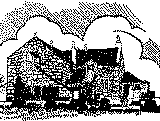 This ancient building owes its foundations to an
early chapel built by the Comyn family at
the end of the 12th or the beginning of the 13th century. This ancient building owes its foundations to an
early chapel built by the Comyn family at
the end of the 12th or the beginning of the 13th century.
The feudal barony of Kirkintilloch had two motte castles - one at Peel
Park, Kirkintilloch and the other here in Cumbernauld. The baron was
responsible for providing a place of worship within his 'fief'. The
parish church of the area was St. Ninian's in Kirkintilloch but to
cover the outlying areas there were also local chapels, known as
'chapels-of-ease', one of which was here in Cumbernauld.
A brief notice appears on record in 1500 when Cumbernauld, like other
places in Britain, was badly hit by the plague - the 'Black Death'. The
village was so decimated that the surviving inhabitants had great
difficulty in carrying the bodies for burial to the parish burial
ground at the old kirk of St. Ninian's at Kirkintilloch. The
parishioners made an application to the See of Glasgow, within whose
jurisdiction Cumbernauld fell, for permission to open a new burial
ground at the Chapel of Cumbernauld.
With the advent of the Reformation the old chapel fell into disuse and
soon became roofless and ruinous. In 1621 the Earl of Wigton made
application to the Commissioners for the Plantation of Kirks to have a
church erected on his estate at Cumbernauld. The application was
refused but the earl's chaplain began to hold regular services in the
hall of Cumbernauld castle. As a result the parish of Lenzie was
divided into two - Easter and Wester Lenzie, which became the parishes
of Cumbernauld and Kirkintilloch respectively. It was necessary for the
new parish to have its church erected as quickly and as cheaply as
possible. This was done by the repair of the old walls of the original
chapel ruins and the erection of a new roof upon them.
The 'new' church was ready for occupancy by the end of the following
year - 1650.
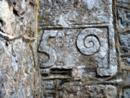 The population within the
parish continued to grow and by 1659 it was necessary to increase the
size of the church by adding the North Aisle. This allowed the minister
to have the pulpit in the middle of the south wall and thus see all
sections of the kirk at once - a common arrangement in those days, and
still in use today. The population within the
parish continued to grow and by 1659 it was necessary to increase the
size of the church by adding the North Aisle. This allowed the minister
to have the pulpit in the middle of the south wall and thus see all
sections of the kirk at once - a common arrangement in those days, and
still in use today.
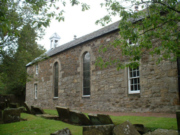 By the end of the eighteenth
century growing prosperity and an increase in population within the
parish resulted in the church being further enlarged by adding an
additional storey to the main block and wing. The erection of galleries
with outside stairs to serve them and the insertion of two fine tall
windows to the south completed these alterations. By the end of the eighteenth
century growing prosperity and an increase in population within the
parish resulted in the church being further enlarged by adding an
additional storey to the main block and wing. The erection of galleries
with outside stairs to serve them and the insertion of two fine tall
windows to the south completed these alterations.
In 1810 the roof was strengthened; heating was introduced in the form
of two stoves; wooden porches were erected at the top of the outside
stairs. Later the earthen floor was covered with flagstones.
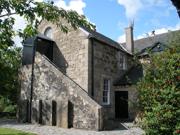 In 1931 before the property was
handed over by the Heritors, another major scheme of renovation work
was embarked upon. Most of the woodwork was renewed and a wooden floor
was laid on the flagstones. During the repairs several tombstones of
notables buried inside the church were removed and placed against the
outside east wall where they remain today. In 1931 before the property was
handed over by the Heritors, another major scheme of renovation work
was embarked upon. Most of the woodwork was renewed and a wooden floor
was laid on the flagstones. During the repairs several tombstones of
notables buried inside the church were removed and placed against the
outside east wall where they remain today.
|
|
|

